
An exterior paint job in Houston is fighting the weather from the day it goes on. Sun, heat, humidity, and heavy rain all work on the outside of a house year round, and they work faster here than in most of the country.
That is why two houses painted the same year can look completely different a few summers later. The difference is rarely the color or even the paint. It is the prep, the timing, and whether the job was planned around how this climate actually treats a house. Here is how exterior house painting works in Houston, Spring, and The Woodlands, and what decides how long it lasts.
What exterior house painting covers
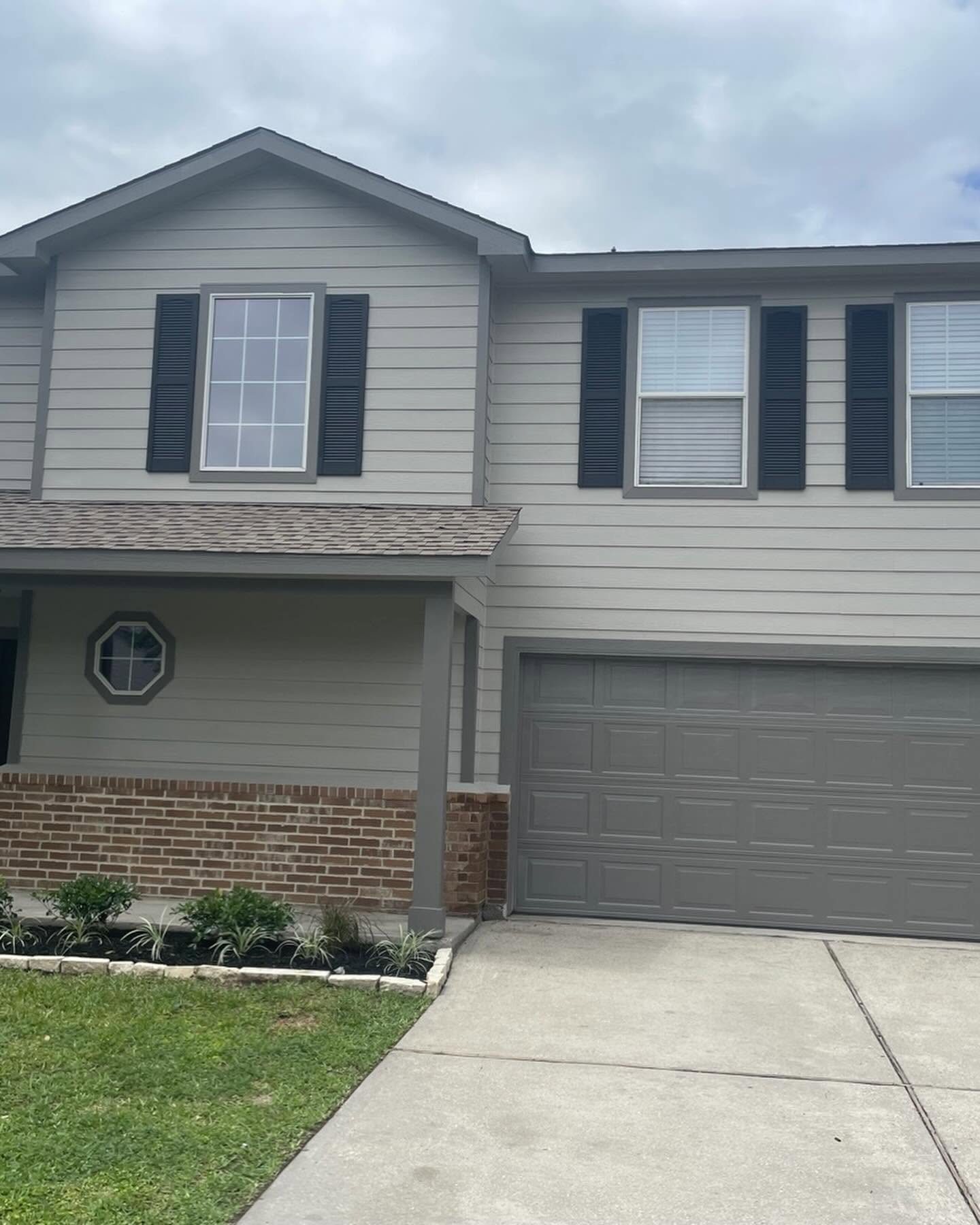
A full exterior repaint usually takes in the siding, the trim, the fascia and soffits, the doors, the garage door, and the shutters. Many homes also include fences, decks, and the painted parts of the porch.
Each of those surfaces ages differently. Fascia and trim on the sunny side of the house fail first. Doors and garage doors take a beating from hands, cars, and weather. Fences and decks are their own category, since wood that is stained and sealed needs different treatment from painted siding.
Getting clear on the scope at the start avoids surprises later, and it is the first thing we walk through at an estimate.
How Houston weather works on exterior paint
Three things do most of the damage here: ultraviolet light, moisture, and heat.
Sunlight breaks down paint films over time, which is what causes fading and chalking, especially on south and west facing walls. Moisture gets behind paint through failed caulk, open joints, and bare wood, and that is what causes peeling and rot. Heat makes materials expand and contract every day, which stresses joints and seams.
The National Weather Service Houston/Galveston office keeps the local climate records. The short version is long hot summers, high humidity most of the year, and heavy rainfall. A good exterior job is planned around all three.
Humidity, mildew, and why surfaces need cleaning first
Humidity is the reason so many houses here have green or black streaks on the shaded sides. That is mildew and algae, and it grows on siding, trim, and soffits wherever moisture lingers.
Painting over it does not solve it. The growth continues under the new paint and comes back through it. The EPA's guidance on mold makes the same point for buildings in general: the key to controlling mold is controlling moisture.
So every exterior job starts with getting the surfaces clean and dealing with growth properly. That is the foundation for everything else.
How often to repaint the exterior of a house in Houston
This is one of the most common questions we get, and the honest answer is that it depends on the siding, the exposure, and how well the last job was done.
Instead of a fixed number of years, look at the house. Chalky residue that rubs off on your hand, fading on the sunny walls, cracked or missing caulk, peeling on trim, and bare wood showing anywhere are all signs that it is time.
Waiting too long costs more. Once paint fails and water gets into wood, a repaint turns into a repair job. Repainting while the surface is still sound is almost always the cheaper route.
The best time of year to paint a house exterior here
Paint needs the right conditions to go on and to cure. Very high heat, direct midday sun on a wall, rain, and heavy dew all affect how it performs.
In this area, spring and fall usually offer the most comfortable stretches, but exterior work happens year round. What matters more than the month is planning each day around the conditions: working walls as they come out of direct sun, keeping an eye on the afternoon rain, and not coating surfaces that are wet.
A painter who talks to you about weather and scheduling before color is a painter planning for the finish to last.
Siding types in Spring and The Woodlands
Homes around here use a mix of materials, often on the same house. Fiber cement lap siding, wood siding and trim, brick, stucco, and some vinyl all show up regularly.
Each takes paint differently and needs different prep. A typical two story home in a Spring or Woodlands neighborhood might have brick on the lower level, fiber cement on the upper level, and wood or composite trim throughout.
That mix is normal, and it is one of the reasons we look closely at the house before quoting rather than pricing by square footage alone.
Painting fiber cement siding
Fiber cement is one of the most common siding materials on newer homes in this area, and it takes paint well when it is prepared properly.
The usual issues are failed caulk at the butt joints and around windows, chalking on older factory finishes, and edges that have taken on water where paint has worn away. Those get addressed before any coating goes on.
Fiber cement holds paint well, which means a good repaint can look sharp for a long time. It also means a poor repaint is a waste of a good substrate.
Wood siding, trim, and rot repair
Wood is where Houston humidity shows up first. Bottom edges of trim, window sills, door frames, and anywhere water sits are the usual problem areas.
Soft or rotted wood has to be repaired or replaced before painting. Paint over rot just hides it for a season and seals moisture in. Sound wood gets scraped, sanded, and spot primed where bare.
We point out any rot we find at the estimate, so the repair is part of the plan instead of a surprise halfway through the job.
Painting brick exteriors
Painted brick is a popular way to update an older home, and plenty of brick in this area has been painted already. It is a real commitment though, because once brick is painted, going back is difficult and expensive.
Brick needs to be clean and dry, and the mortar needs to be sound. Brick and mortar breathe, so the coating has to suit masonry rather than be a standard siding paint.
If your brick is already painted and peeling, the job is about removing what is failing and restoring a sound surface first. If it has never been painted, we will talk through the decision honestly before you commit.
Stucco and masonry surfaces
Stucco shows up on many homes and commercial buildings around here, often alongside brick or siding.
Hairline cracks are common and are filled before painting. Larger cracks can point to movement that needs attention first. Like brick, stucco needs a coating suited to masonry that allows the wall to breathe.
Stucco can be sprayed and back rolled for an even finish. The texture hides a lot, but it also holds dirt and growth, so cleaning is especially important.
Pressure washing before paint
Washing is not optional on an exterior repaint. Dirt, chalk, pollen, mildew, and grime all stop new paint from bonding to the surface.
The wash also needs the right pressure for the surface. Too much pressure can damage siding, force water behind it, or etch soft wood. Then the house needs time to dry before any coating goes on.
Our pressure washing crews handle this as the first stage of the job, so washing and painting are scheduled together rather than weeks apart.
Scraping, sanding, and priming
After washing comes the slow part. Loose and peeling paint gets scraped back to a sound edge. Rough areas get sanded smooth so the old edges do not telegraph through the new finish. Bare wood and repaired areas get primed.
None of this shows in the finished photos. It is also the part that decides whether the new paint stays on the house.
When one exterior quote is much lower than another, the difference is very often hidden here.
Soffits, fascia, and the roofline
The roofline is easy to overlook from the ground and very obvious once it starts failing. Fascia boards take direct sun and runoff from the roof, and soffits trap humidity under the eaves.
Peeling fascia is often the first visible sign that a house is due. It is also where wood rot hides, especially behind gutters and at the corners where two boards meet.
Soffit vents need to stay open and clean rather than painted shut, since they help the attic breathe. That detail matters more in a hot, humid climate than almost anywhere else.
Two story homes and access
Most homes in the newer Spring and Woodlands neighborhoods are two stories, which makes access a real part of the job. Tall gable ends, second story windows over a roofline, and walls above flower beds all need the right ladders and setup.
Access affects time and safety more than people expect. It is also where shortcuts show up, because the hardest areas to reach are the easiest to skimp on.
We plan the setup around the house so the second story gets the same prep and attention as the parts you can reach from the driveway.
Caulking joints and gaps
Caulk is the seal between the siding, the trim, and everything else, and in this heat it gives up over time. Cracked, shrunken, or missing caulk lets water get behind the paint.
Failed caulk gets cut out and replaced at butt joints, corners, window and door trim, and anywhere two materials meet. Sound caulk can stay.
This step keeps water out of the walls as well as making the house look tighter and cleaner when the job is done.
Older homes and lead paint
If your house was built before 1978, lead paint is a real consideration, and some of the older housing stock around Houston falls into that range.
The EPA's Renovation, Repair and Painting Program requires anyone paid to disturb painted surfaces in homes built before 1978 to be certified and to follow lead-safe work practices. Scraping and sanding an exterior disturbs paint by definition.
Most homes in the newer Spring and Woodlands neighborhoods were built well after that date, but if you are not sure of your home's age, find out before any work starts.
Choosing exterior paint colors
Exterior colors look very different on a whole wall than on a small swatch. Strong sun washes colors out, and shaded walls make them look darker.
Look at samples on the house itself, on more than one side, at different times of day. Think about the roof, the brick, and the parts of the house you are not painting, since those set limits on what works.
We include a free color consultation with our estimates, which helps narrow the choice down before anyone buys paint.
HOA approval in master planned communities
Many neighborhoods in Spring, The Woodlands, and the surrounding area have HOAs with rules about exterior colors and changes.
Check your HOA's guidelines before you choose colors. Many associations require an application and approval before an exterior color change, even when you are repainting close to the existing scheme. Some publish approved palettes.
It is much easier to get approval before the work than to deal with a violation letter after the house is painted.
Doors, shutters, and garage doors
The front door and the garage door are the most noticeable parts of the outside of a house. A new color on either one can change how the whole home reads from the street.
Doors take more handling and more weather than siding, so they need careful prep and a durable finish. Shutters are often taken down or carefully masked so the siding behind them is painted properly too.
A black or deep colored front door is a popular update, and it pairs well with a full exterior repaint.
If the garage door is getting a new color, it is worth thinking about the floor behind it at the same time. Our post on epoxy flooring in Houston covers what goes into a garage floor that holds up to this climate.
Fences, decks, and outdoor wood
Fences and decks are usually stained and sealed rather than painted, and they need their own schedule because they wear faster than the house.
Wood needs to be clean and dry before stain goes on. Weathered gray wood often needs cleaning and brightening first so the stain soaks in evenly.
These are good jobs to combine with an exterior repaint so the whole property looks finished at the same time.
Protecting landscaping, windows, and driveways
An exterior job happens right next to everything you care about outside: plants, windows, light fixtures, walkways, and cars.
Plants get covered or tied back, windows and fixtures get masked, and walkways and driveways get drop cloths where we are working above them. Overspray and drips are prevented rather than cleaned up afterward.
Tell us about anything delicate at the estimate, such as new landscaping, an outdoor kitchen, or a pool area, so it is part of the plan from day one.
How long an exterior repaint takes
The timeline depends on the size of the house, the condition of the surfaces, how much repair is needed, and the weather.
The order is consistent: wash, dry, repairs, scrape and sand, caulk, prime, paint, and a final walkthrough. Rain days push the schedule, and building in some flexibility is better than rushing a coat onto a wet wall.
You will get a schedule with your estimate based on your house, and we will keep you updated if weather moves it.
What drives the cost of exterior painting
People often search for a price to paint a house of a certain size, and square footage does matter. It is far from the only factor.
The condition of the surfaces is usually the biggest variable. A house with sound paint and good caulk is a very different job from one with peeling trim, rotted wood, and failed joints. Height and access matter, as do the number of colors, the amount of trim, and how many doors, shutters, and extra surfaces are included.
That is why we quote after walking the house. The estimate is free and written, and it spells out exactly what is included.
The final walkthrough
Every exterior job should end with a walkthrough of the whole house together, not just a text saying the crew has left.
That is the time to look at the trim lines, the doors, the high areas, and anything you want touched up. It is also when the site should be clean, with masking removed, drop cloths gone, and plants uncovered.
Our process includes a satisfaction walkthrough before the job is closed out, so you can point out anything that needs attention while the crew is still there.
What to ask an exterior painting contractor
Ask how they clean the house before painting and how long they let it dry. Ask what prep is included, specifically, including scraping, sanding, caulking, priming, and wood repair.
Ask how they handle weather delays, what surfaces are included in the price, and how the job site is protected. Ask to see exterior homes they have painted locally.
The Painting Contractors Association maintains standards and training for the trade. A contractor who can explain their prep in detail is describing a plan rather than just a price.
Exterior painting in Spring, The Woodlands, and nearby
We paint home exteriors across North Houston, Spring, The Woodlands, Tomball, Kingwood, and Conroe. If you are local to Spring, our painters in Spring, TX page covers that area, and our painters in The Woodlands page covers The Woodlands.
Exterior work is part of our full residential painting service, which also covers interiors, cabinets, doors, and trim.
Get a free exterior painting estimate
ARC Painting Solutions is locally owned, licensed, and insured, with a 5.0 star Google rating. Our hours are Monday 8:00 AM to 5:00 PM, Tuesday 8:00 AM to 6:00 PM, Wednesday 8:00 AM to 5:30 PM, and Thursday through Saturday 8:00 AM to 5:00 PM.
Get a free, written estimate for your home's exterior.
Call (346) 382-5373 or request a quote at https://arcpaintingsolutions.com
Locally Owned. Quality Driven.
Ready to Start Your Project?
Get a free, no-obligation estimate from a locally owned crew that shows up and does it right.
