
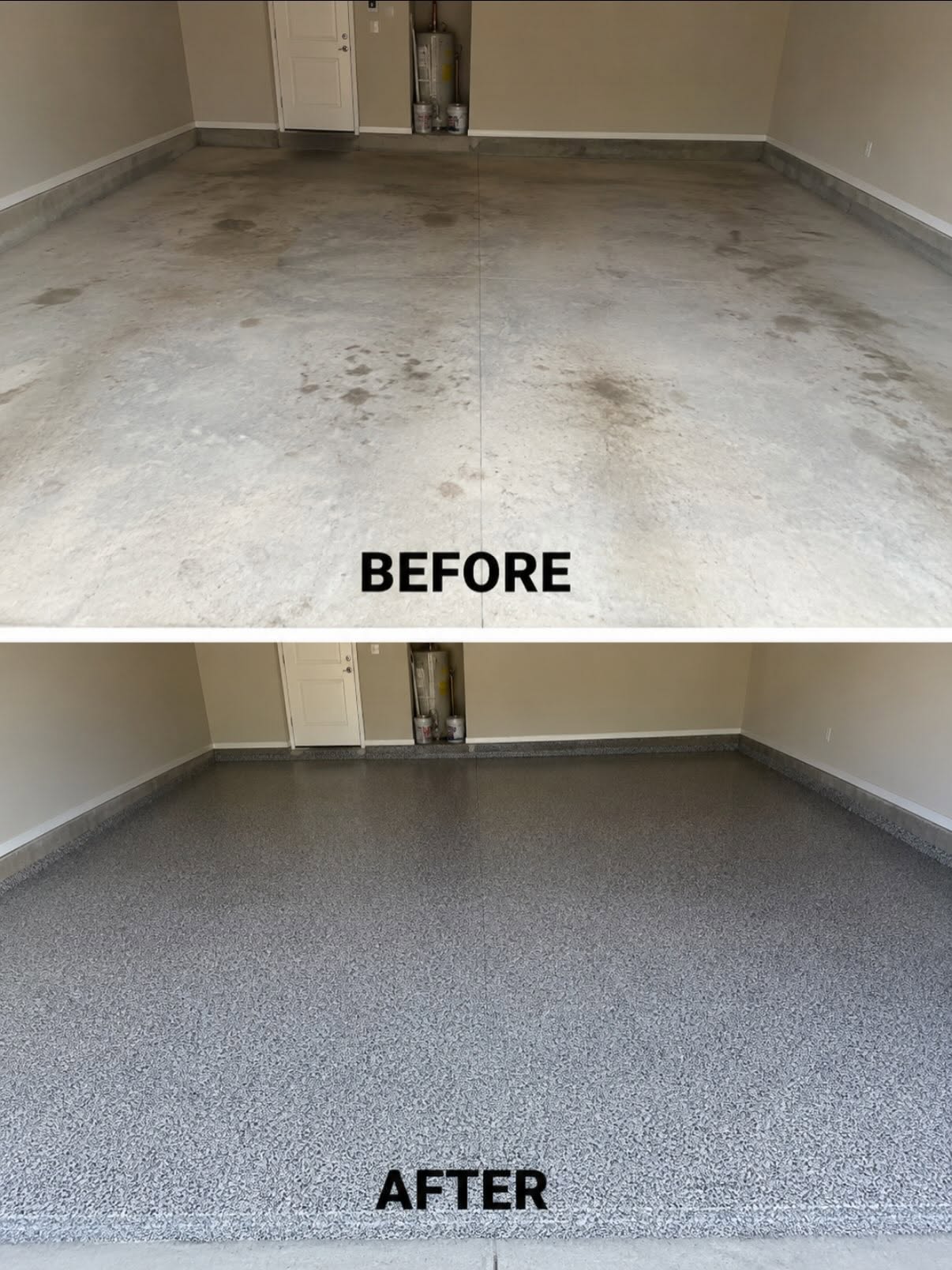
A bare concrete garage floor in Houston has a hard life. It takes hot tires in August, wet tracks from every afternoon storm, oil drips, dropped tools, and a coat of dust that never quite goes away. An epoxy floor changes all of that, and it changes how the room looks more than almost anything else you can do to it.
The difference between an epoxy floor that still looks sharp years from now and one that starts lifting at the edges is almost never the product. It is the slab, the prep, and the conditions on the day it goes down. Here is how epoxy flooring works in Houston, what the options are, and what actually decides the cost.
What epoxy flooring is
Epoxy is a two-part resin coating. The resin and the hardener are mixed on site, applied to prepared concrete, and cure into a hard, seamless surface that is bonded to the slab rather than sitting on top of it like a mat or a tile.
That bond is the whole point. A properly installed epoxy floor becomes part of the concrete. It does not have seams for water to get under, it does not have grout lines to stain, and it does not peel the way a single coat of garage floor paint does.
It is also why preparation matters so much. A coating that is meant to become part of the slab can only be as sound as the slab surface it is bonded to.
Epoxy floor coating versus garage floor paint
These get confused constantly, partly because some products sold as epoxy paint are mostly paint with a little epoxy in them.
Floor paint is a film. It sits on the surface, it wears through where tires turn, and hot tires can lift it straight off the concrete. Most people who have tried it once have seen exactly that happen in the two tracks where they park.
A true epoxy coating system is thicker, harder, and bonded to a mechanically prepared surface. It behaves like a floor rather than a finish. If you are comparing quotes, ask what the system actually is and how the slab gets prepared before it goes down, because that answer tells you which of the two you are buying.
Why Houston garages are hard on floors
Our climate does a few specific things to concrete and to anything bonded to it.
Heat is the obvious one. A garage with the door down in summer gets very hot, and a car that has just come off the freeway brings hot tires straight onto the floor. Humidity is the less obvious one. Moisture in the air and moisture moving up through the slab both affect how a coating bonds and cures.
Then there is water. Afternoon storms, pooled water from wet cars, and in some neighborhoods the occasional flood. The National Weather Service Houston/Galveston office publishes the local climate records, and anyone who has lived here a few summers does not need to read them to know what they say.
A coating system for a Houston garage has to be chosen with all of that in mind.
The epoxy systems we install
We install three main residential finishes, and each one suits a different kind of space and a different kind of owner.
Flake, metallic, and quartz all start from the same prepared slab and the same idea of a bonded resin floor. What changes is what goes into or onto the resin, which changes the look, the texture underfoot, and how forgiving the floor is day to day.
The right choice depends on how you use the space, how much grip you need, and how much you care about the floor hiding dust and scuffs between cleanings.
Flake epoxy garage floors
Flake is the most popular garage floor for a reason. Multi-colored vinyl flakes are broadcast into a solid base coat and sealed in, which gives you a speckled, textured finish that looks like a finished floor rather than painted concrete.
It is extremely forgiving. Dust, small scuffs, and the odd tire mark disappear into the pattern instead of standing out on a solid color. The texture also adds a little grip compared with a perfectly smooth surface.
If your garage is a working garage, with cars, bikes, tools, and kids moving through it every day, flake is usually where we start the conversation.
Metallic epoxy floors
Metallic epoxy uses pigmented metallic powders in the resin to create depth, movement, and a reflective finish that looks a little different in every room. Coppers, bronzes, blues, grays, and blended colors are all possible.
It is a showpiece floor. People choose it for show garages, game rooms, home gyms, and spaces where the floor is meant to be part of the design rather than just the surface you walk on.
The trade-off is that a high-gloss metallic finish shows more than flake does. Dust and footprints are more visible on a reflective surface, so it suits owners who like the look enough to keep it wiped down.
Quartz epoxy for wet and high-traffic areas
Quartz systems broadcast quartz aggregate into the resin, which creates a textured, gritty surface with real grip.
That makes it the better choice where floors get wet or see constant foot traffic. Patios, mudrooms, around pool equipment, wash bays, and commercial spaces where people walk through with wet shoes all benefit from the extra traction.
It is less about the look and more about how the floor performs underfoot, although quartz blends can be very clean and modern in the right space.
Epoxy vs polyaspartic
You will see polyaspartic coatings advertised alongside epoxy, sometimes as a replacement for it, so it is worth understanding the difference.
Polyaspartic is a different chemistry that is often used as a top coat or as a faster curing system. It is frequently marketed on speed and on resistance to yellowing in sunlight. Epoxy has a long track record as a base coat, builds thickness well, and bonds strongly to prepared concrete.
The useful question is not which word is better. It is what the full system is, layer by layer, and whether it suits your slab and your space. Ask any installer to walk you through each layer and why it is there.
Why surface prep decides how long the floor lasts
Almost every early epoxy failure comes back to prep. Not the product, not the color, not the brand. Prep.
Concrete straight from the builder, or concrete that has been sealed, painted, or soaked in years of oil, does not give a coating anything to hold. The surface has to be opened up so the resin can bond into it rather than just sit on top of it.
That is why the first day of a real epoxy job is loud and dusty and does not look like progress. It is the part that decides whether the floor is still bonded years from now.
Diamond grinding the slab
We prepare garage slabs by diamond grinding. A grinder with diamond tooling takes off the top layer of the concrete, removes old coatings and contamination, and leaves a profiled surface that a resin system can grip.
Grinding also shows you what the slab is really like. Patches, old sealers, and hidden damage come to the surface during prep, which is the right time to find them.
The alternative some people use is acid etching. It is cheaper and quicker, but it is far less consistent, and it does not remove sealers or coatings. For a floor you want to last, grinding is the standard.
Cracks, spalling, and joint repair
Most garage slabs in this area have some cracking. Houston soils move, slabs settle, and hairline cracks are normal rather than a sign that something is wrong with your house.
Cracks, chips, and spalled areas get repaired before the coating goes down. Control joints, the straight cuts in the slab, are handled deliberately, either filled or honored depending on the floor and what you want it to look like.
What a coating cannot do is stop a slab from moving. If a crack is actively opening, a coating will follow it eventually. We will tell you at the estimate if we see a crack that looks structural rather than cosmetic.
Moisture in the slab and how it gets checked
Moisture is the hidden enemy of an epoxy floor. Water vapor moving up through a slab can push against a coating from underneath, and that pressure is behind a lot of the bubbling and peeling people see on poorly installed floors.
Concrete moisture can be measured rather than guessed at. The industry has standard test methods for it, including ASTM F2170, which measures relative humidity inside the slab using in-place probes.
Not every residential garage needs a full test program, but every slab needs to be assessed. Where moisture is a concern, the system changes to account for it rather than hoping for the best.
Weather on the day of the install
Epoxy is sensitive to temperature and humidity while it cures, which in this climate means the install day matters.
Very hot garages, very humid days, and garages with the door open to an afternoon storm all affect how a coating behaves. We plan installs around the conditions, control the space as much as we can, and would rather move a day than put a floor down in the wrong weather.
This is one of the less visible differences between installers. A good one will talk to you about timing before they talk to you about color.
Stem walls and the edges of the room
The low concrete curbs around the edge of many garages, the stem walls, are easy to forget and very noticeable when they are skipped.
Coating the stem walls along with the floor gives the room a finished, built-in look and protects the part of the wall that gets splashed, bumped, and swept against. It also takes the finish right to the edges instead of stopping at a line that collects dirt.
We recommend including them. If the walls above are tired, our residential painting crew can repaint them before the floor goes in, so the whole room is finished at once.
How long an epoxy install takes
There is no honest single number, because it depends on the size of the floor, the condition of the slab, how much repair is needed, and the system you choose.
What is predictable is the order. Prep and grinding, repairs, the base coat, any flake or quartz broadcast, the top coat, and then curing time before the floor goes back into service.
You will get a schedule with your estimate based on your garage rather than an average. The cure period before you can walk on it and before you can park on it are two different things, and we will tell you both before we start.
Getting your garage ready for install day
The floor has to be empty. Cars out, shelving off the floor or moved, and everything that lives on the slab somewhere else for the duration.
Most people underestimate how long that takes. Plan for clearing the garage as its own project before the install date rather than the morning of.
It is also worth planning where the cars will live while the floor cures, and making sure anyone in the house knows not to open the garage door or walk across the floor early, however finished it looks.
Patios and outdoor concrete
Epoxy is not only for garages. Covered patios and outdoor living areas can be coated as well, with a few extra considerations.
Sunlight, drainage, and water all matter more outside. The system has to suit an exterior space, and textured finishes are often the better choice where the floor gets wet. Covered areas are generally better candidates than fully exposed slabs.
Before any outdoor coating, the concrete needs to be properly clean. Our pressure washing service is often the first step on patio and outdoor projects.
Basements, game rooms, and home gyms
Interior spaces are where metallic and decorative finishes really shine. Game rooms, home gyms, workshops, and converted spaces all benefit from a floor that is seamless, easy to clean, and stands up to dropped weights and rolling equipment.
Indoor slabs bring their own considerations, especially around moisture and ventilation during the install. We look at both before recommending a system.
A gym floor and a showroom floor need different things. Telling us how you actually use the room is the best way to get the right finish.
Commercial and industrial epoxy flooring
Commercial floors are a different job from garages. Warehouses, workshops, commercial kitchens, retail floors, and back-of-house areas need systems built for forklifts, carts, chemicals, and constant traffic.
Safety matters more too. Slip resistance, line striping, and clearly marked walkways are part of the design rather than extras. OSHA's walking-working surfaces standards apply to workplaces, and the floor is part of how a business meets them.
Scheduling also changes. Commercial floors often have to go down after hours or in sections so the business keeps running, the same way our commercial painting work is planned around occupancy.
Walls first, then floors
If a project includes painting and a new floor, the walls get done first. Paint drips, ladder feet, and drop cloths are all things you do not want on a brand new floor coating.
This is one of the reasons we often scope flooring and painting together. It keeps the order right and avoids the cost of protecting or repairing a fresh floor later.
We wrote about this sequencing in more detail in our post on commercial painting in Houston, and the same logic applies to a garage.
What drives the cost of an epoxy garage floor
People search for a price per square foot, and it is understandable, but size is only one part of the cost.
The condition of the slab is often the biggest variable. A clean new slab needs less work than one with old paint, heavy oil staining, wide cracks, or spalled areas. Moisture concerns can change the system. The finish matters too, since flake, quartz, and metallic systems involve different materials and labor. Stem walls, steps, and odd shapes add time.
That is why we quote after seeing the floor rather than over the phone. The estimate is free, and it will tell you exactly what your slab needs and why.
Flooding and garage floors
Some Houston neighborhoods take water in garages during heavy storms. If yours has, it is worth knowing before choosing a floor.
The Harris County Flood Control District publishes flood risk information and resources for residents. A bonded, seamless coating is far easier to clean after water than bare concrete, and it does not soak up contamination the way an uncoated slab does.
What a coating cannot do is make a garage flood-proof. If water comes in, the floor will need cleaning like everything else in the room, but it will clean up far better.
Caring for an epoxy floor
Epoxy floors are low maintenance, which is a big part of their appeal. A dust mop or soft broom for regular cleaning, and a damp mop with a mild cleaner when it needs more.
Avoid harsh acidic cleaners and abrasive pads, which can dull the finish. Wipe up oil, brake fluid, and chemical spills when they happen rather than letting them sit. Hot tires are fine on a properly installed system, but putting mats under jack stands and kickstands protects the surface from point loads.
A floor that gets cleaned regularly stays looking new for far longer than one that only gets attention when it is filthy.
Questions to ask any epoxy installer
Ask how they prepare the slab, and whether they grind or etch. Ask how they assess moisture. Ask what each layer of the system is and why it is there.
Ask how they handle cracks and control joints, whether stem walls are included, and what the cure schedule is before you can walk and park on the floor. Ask to see garage floors they have actually installed, not just showroom samples.
An installer who can answer those questions clearly is describing a process. One who only talks about colors and price is describing a product.
Where we install epoxy floors
We install epoxy flooring across North Houston, Spring, The Woodlands, Tomball, Kingwood, and Conroe, for garages, patios, basements, and commercial spaces. You can see finishes and recent projects on our epoxy flooring page.
ARC Painting Solutions is locally owned, licensed, and insured, with a 5.0 star Google rating. Our hours are Monday 8:00 AM to 5:00 PM, Tuesday 8:00 AM to 6:00 PM, Wednesday 8:00 AM to 5:30 PM, and Thursday through Saturday 8:00 AM to 5:00 PM.
Get a free estimate for your floor.
Call (346) 382-5373 or request a quote at https://arcpaintingsolutions.com
Locally Owned. Quality Driven.
Ready to Start Your Project?
Get a free, no-obligation estimate from a locally owned crew that shows up and does it right.